
You've Got This Secrets from a Contractor
A pro’s take on improving your home’s energy.
Share


Get a pro's take on improving your home.
Isaiah Allen talks and acts with the quiet confidence of a person who has found his calling. He is in his element when he’s at work. Which makes sense, after all, he runs the company. Once a contractor himself, he still enjoys taking the time to be in a client’s home while training an employee. And that’s how he’s wired. The man is built to help others. You can see it in his work and how he works with others. We sat down with Isaiah and his colleague David Taylor to get their take on saving at home.
How did you get into this whole thing?
I got in the industry in 2012. I recently graduated from high school—I graduated in 2010. I was going to school and then when you leave and you come back, I couldn’t go back to my old job; it was already filled.
Someone who played on my old basketball team, his next-door neighbor started a company in this industry and recommended me. I started out on the multifamily crew just installing light bulbs, showerheads and aerators. I wanted to learn the business—how they ran it.
So I applied for a position as a technical operations assistant.
At first, I got denied, but I kept pressing and eventually got the job. I was able to see the different service lines, how everything came together and how EmPOWER Maryland fed into it. I was able to see it from a different lens. I was there for about 4 and a half years. Then I got with Advanced Green Home Solutions (AGHS) and have been growing this company since 2017. We went from about five people when I started to about 40 or 45 now.
What do you love about the job?
Because we use building science principles, we know what we do works. It’s not guessing; it’s measurable. We do the full service: visual inspections, Quick Home Energy Check-ups (QHEC), energy audits and full installations. When our auditors pitch recommendations, it’s really a consultation.
We’re not pushing anything; we tailor it to the customer’s needs. We’re not getting over on a customer; we’re trying to help them and, in turn, helping the entire grid and environment. Also, I like giving others the same opportunities I was given. It took someone taking a chance on me to let me learn and grow, and I like doing that for others.
How easy is it to convince a person you’re there to help? Does it take long for them to figure it out?
You have to be personable and have a conversation rather than it being strictly technical. If you just send a report, it seems “salesy.” You build a rapport while doing the work. Sometimes it’s tough to get them to speak to you, but once they hear the explanation of charges and the purpose of the program, they understand the value.
I use the example of a 60-watt light bulb versus a 9-watt bulb—that’s low-hanging fruit to show value. It’s harder to show value for things like insulation or air sealing because the customer doesn’t see them all the time like they do a new window or HVAC unit.
Do you miss being in the field?
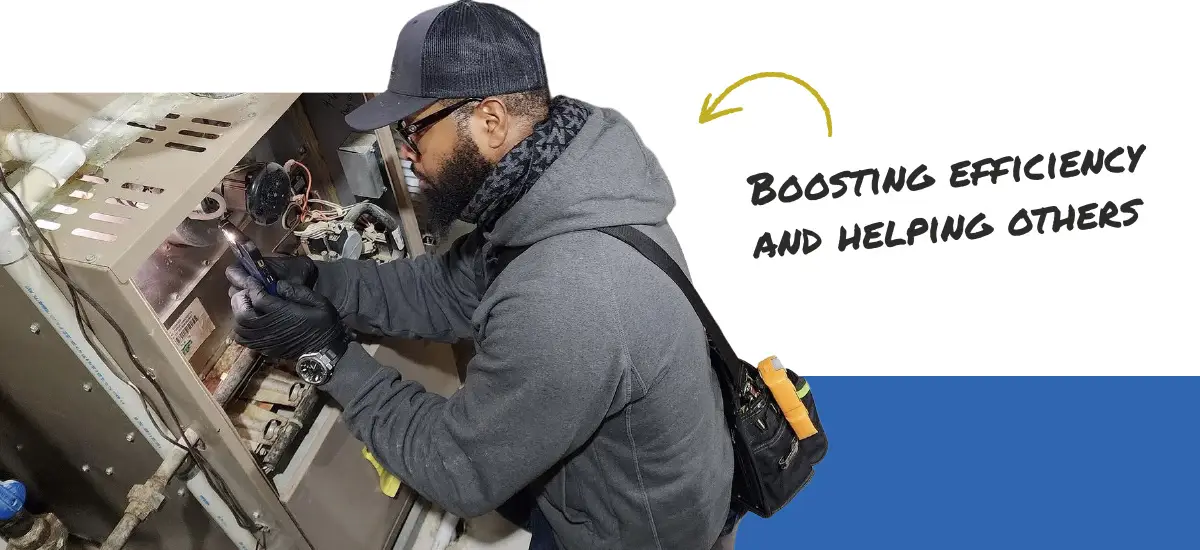
I still go out because I’m training my team. It’s all hands on deck. I enjoy meeting different people—connections are how the world moves. But I also enjoy the administrative part and watching the company grow. It’s stressful managing different people and expectations, but I care about the AGHS family. They have families to support, and I look at them like my own. My daughter was born when I started with this company, so I look at it that way.
What is a quick win you usually advise for energy efficiency?
For customers who haven’t participated in EmPOWER Maryland, the programs help everyone overall because they reduce the strain on the grid. If those projects weren’t done, rates would probably be higher for everyone from the jump. It’s a collective effort. I’m not a “closer” or a seller, but I focus on educating. It’s on the profession to get in front of customers and have these conversations.
What are the typical problems customers come to you with?
Bills are too high, or a particular room is too cold. Often the upstairs is hot and sticky in the summer while the downstairs is freezing—sometimes a 10-degree difference. But too often, we find health and safety hazards unrelated to the initial call. People are unaware of mold, mildew or moisture in basements and crawl spaces. We find houses with no air sealing or leaking fossil fuels and gas.
I was once at an audit testing a gas stove for safety, and the detector went off the charts for carbon monoxide. The mother was feeding her daughter breakfast just four feet away. She had no idea she was being poisoned every morning. Our motto is “first, do no harm.”
I have to see the conditions of the home before I air-seal it, because if I tighten a house up without fixing a leak, I keep those hazards inside. Delivering that news can be a tough pill to swallow, especially if they’ve already spent $30,000 on new windows because a salesman told them they’d see a 30% improvement, which isn’t always true. That’s where rebates are helpful—they help you make the changes you actually need.
Do you get follow-up from excited customers?
Yes, because we do the work. We have lifelong customers. I had a customer contact me 2 days ago because a different contractor did a project that didn’t go well. I fixed it, then fixed her neighbor’s roof leak that was affecting her home. If you reintroduce someone to their home in a thorough way, you’re always top of mind. People call me for opinions on roofs or siding even though I don’t do that work, because they trust me.
Do you have recommendations for ways people can check things themselves before they even call you?
I’ll give you two easy ones. First, if you have attic access, pop your head up there. If you only see a couple of inches of insulation, you could benefit from work. Second, check for pressure variances. If you open the front door and a bedroom door elsewhere in the house moves or closes on its own, there’s a pressure problem. Those are telltale signs.
Do you notice this stuff when you’re off the clock?
You can’t help it! I’ll be at a friend’s house asking why they still have certain light bulbs. In the winter, I notice which houses have snow on their roofs and which don’t [indicating heat loss]. My kids get sick of listening to it. It’s always on the brain.